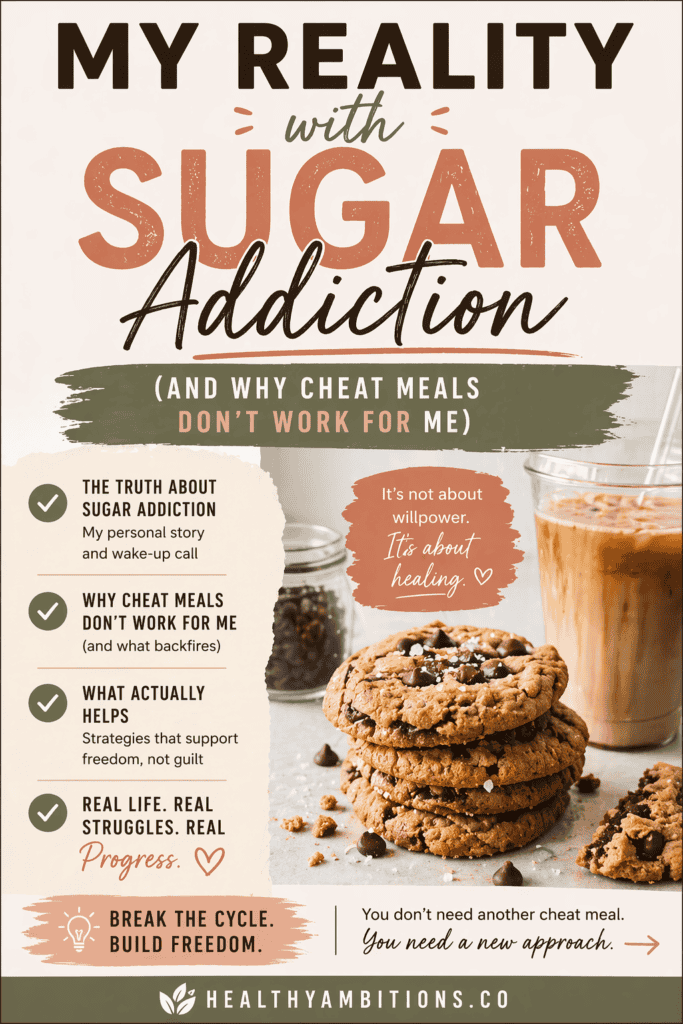
My Reality with Sugar Addiction — And Why Cheat Meals Don’t Work for Me Meta Description: If you’ve ever had one cheat meal turn into a week-long spiral, this is for you. Here’s my honest take on sugar addiction, cheat meals, and what actually works for weight loss maintenance.
I’m just going to say it:
I’m addicted to sugar.
Not in a cute, “I love dessert” way. Not in a “I treat myself on weekends” way.
In a very real, very inconvenient way — where sugar is my first instinct when I’m stressed, what I automatically reach for when I want to celebrate, and the thing I would consume on autopilot without even realizing I’d made a decision.
For a long time, I tried to manage that by doing what everyone says to do.
I tried cheat meals.
They didn’t help me. They hurt me.
This post may contain affiliate links, which helps keep this content free. Please read our disclosure for more info.
Why Cheat Meals Don’t Work When You Have a Sugar Addiction
A lot of people swear by planned cheat meals. And for some people, they genuinely work — they provide relief from restriction, help with mental sustainability, and don’t derail progress.
I am not that person.
For me, one cheat meal didn’t just satisfy a craving and let me move on. It opened a door I had a hard time closing. What actually happened every time:
- One cheat meal turned into multiple days of intense cravings
- Bloating and inflammation that I could see and feel
- Brain fog that made everything harder
- Gut issues that took days to fully clear
- The mental spiral of feeling like I’d undone my progress
The hardest part wasn’t the physical symptoms. It was the fact that it would take me three to five days to feel normal again after one unplanned meal. Not one week. Several days.
That’s not balance. That’s not sustainable. That’s a cycle.
[→ Related: Anti-Inflammatory Eating — How I Stopped the Cycle]
What I Did Instead of Cheat Meals During Weight Loss
I didn’t do cheat meals during my weight loss phase at all. Not one.
Instead, I focused on finding alternatives that didn’t trigger the response. Healthier versions of the foods I loved. Different ways to reward myself that had nothing to do with food.
That last one was a bigger shift than I expected.
I had to genuinely rewire how I thought about rewards. For most of my life, food was how I celebrated, how I comforted myself, how I marked a hard day ending. Untangling that wasn’t quick — but it was necessary.
Now when I want to reward myself, I’ll make a small Amazon purchase, do something for my own self-care, or just protect my time and space for a few hours. None of that involves food.
That shift changed everything.
I Didn’t Even Attempt a Cheat Meal Until 6 Months Into Maintenance
This is the part that might surprise people.
I didn’t even try reintroducing a “cheat” until I was six months into maintaining my weight. Six months.
That time gave me something I didn’t have before: stability. I needed to understand my triggers before I played with fire. I needed enough distance from the binge-restrict cycle to know whether I could handle reintroducing certain things without it unraveling.
And honestly? Even after six months, some things I just don’t reintroduce. Not because I’m being restrictive — but because I know what they do to me. That’s not deprivation. That’s self-awareness.
Sugar Is Still a Trigger — Even in “Healthy” Forms
This one genuinely surprised me.
Once I had done the work to get my eating stable, I assumed that “healthy desserts” and “low-sugar alternatives” would be a safe middle ground. And for some people, they are.
For me, the label doesn’t matter as much as the response. I can eat something technically low in sugar, technically clean, technically keto-approved — and still experience the mental pull toward more. Still feel the craving spike. Still notice the shift in my appetite for the next day or two.
It’s not always about the calories. It’s not even always about the sugar content. It’s about how my brain responds to certain textures, certain sweetness levels, certain combinations.
Understanding that changed how I shop, how I meal prep, and what I keep in my house.
Hormones Make This So Much Harder
There are specific times in my cycle where cravings go from manageable to intense. And if I’m not paying attention — if I’m just white-knuckling through and trying to ignore it — one “small” decision can turn into something that takes days to recover from.
What helped: tracking my cycle and actually mapping cravings to specific phases. I use Flo, but you don’t need a fancy app. Even just writing it down for a month shows you the pattern.
When you can see why your willpower is lower on a Tuesday than it was on a Saturday, you stop blaming yourself and start planning for it. That’s the difference between constantly feeling like you’re failing and actually building a system that accounts for your real life.
[→ Related: Hormones and Weight Loss — What My Doctor Found That Changed Everything]
Your Doctor Should Be in This Conversation
Understanding my hormones and getting actual lab work done was one of the most important things I did for my weight and my relationship with food.
If you can — work with a primary care doctor, get labs done, and find out what’s actually happening inside your body. I was prescribed an estrogen blocker and it genuinely shifted things I had been fighting for years.
If access to that isn’t available to you right now, start with tracking. Track your cycle, your cravings, your sleep, your energy. Patterns will show up. And patterns give you power.
How Food Allergies Changed My Entire Body
I have to talk about this because it’s directly connected to the sugar addiction piece.
When I identified the foods my body was actually reacting to — and removed them — I lost 20 pounds without changing much else. The inflammation dropped. My digestion improved. My cravings became more manageable.
Part of why sugar cravings feel so overwhelming for some people isn’t just habit or emotion. It’s that the gut is dysregulated, the body is inflamed, and it’s using cravings as a signal. When you remove the inflammatory inputs, the signal quiets down.
Build your meals around foods your body actually tolerates. That’s not a diet. That’s just paying attention.
→ Related: How I Found My Food Allergies and Lost 20 Pounds Without Trying
What Happens When I Cave
Let’s be honest. Sometimes I do.
And every single time, it follows the same pattern:
- I feel awful within a few hours
- My gut is wrecked
- Brain fog kicks in the next morning
- Cravings come back stronger for the next two to three days
- I’m fighting myself all over again
It’s not worth it. Not for me.
That’s not me being hard on myself. That’s just the information my body gives me, consistently, every time. At some point, you have to listen.
Why I Don’t Do Cheat Meals Anymore
Because for me, it’s never just one meal.
It’s a chain reaction. Even things marketed as “healthy” — keto desserts, low-sugar sweets, “guilt-free” anything — can send me into a pattern of bloating, cravings, and overeating if I’m not careful.
So I stopped trying to force a strategy that doesn’t fit how I’m actually built. That’s not restriction. That’s just honesty.
What Maintenance Actually Looks Like for Me
It’s not glamorous. It doesn’t look like the version you see on social media.
It looks like structured meals. Minimal processed sugar. Knowing my triggers and planning around them instead of pretending they don’t exist. Respecting what my body tells me even when it’s inconvenient.
It’s not restrictive.
It’s intentional. There’s a real difference.
The Part I Don’t Talk About Enough
I’m raising a child.
And I don’t want them to grow up with food guilt, binge cycles, or the habit of using food to cope with every emotion. Those patterns get passed down — not always through words, but through behavior. Through what they see at the dinner table. Through how the adults around them talk about their bodies and their food choices.
So I had to fix mine first. Not just for the weight. Not just for my health. But because the habits I build now are the ones my kid is absorbing.
That’s motivation that goes deeper than a before-and-after photo.
Final Thought
Not everyone struggles with sugar the way I do. I know that.
But if you do — if one cheat meal turns into a week, if “moderation” has never actually worked for you, if you feel like you’re fighting yourself constantly — you are not broken.
You just need a different strategy than what the internet keeps pushing.
For me, that meant no cheat meals, clear personal boundaries around trigger foods, and real honesty about how my body actually responds. Not how it “should” respond. How it actually does.
And that’s what finally gave me freedom.
If you want to start building a food routine that actually works for your body — not someone else’s — [grab the free Keto JumpStart Guide here]. It’s where I’d start if I were starting over.
Join the email list for weekly tips on low-carb eating, managing cravings, and making this lifestyle actually sustainable.